
Guadalupe County Previous Residents Sources
For a Guadalupe County house history, begin with the most recent parcel and then choose the source that fits the era. The appraisal record identifies the parcel, while the County Clerk's recorded-instrument index supplies the grantor, grantee, recording date, and legal-description trail. Directories and census schedules are household evidence, not ownership proof. Newspaper, probate, and map material help when a person disappears from one source but the address remains important.
| Source | Documented era | Where held | What it can show |
|---|---|---|---|
| GAD parcel record | Current tax-year record | Guadalupe Appraisal District | Owner, site and mailing addresses, parcel IDs, legal description, map |
| ROAM and earlier index route | Current public index plus a separate prior-to-1970 route | County Clerk | Recorded parties, document details, and legal-description chain |
| Seguin directories | 1938 citation; 1963, 1976, 1978, 1980 catalog entries | Regional catalog and library leads | Dated household, address, telephone, and business snapshots |
| Federal census and tax rolls | Census through 1950 public; selective tax-roll collection 1837-1910 | Library, FamilySearch, and archives | Household composition or historical property-tax context |
| Sanborn maps and newspapers | Seguin reels; newspapers from late 1890s to current year | Seguin Public Library | Building context, public notices, obituaries, and address clues |
The Guadalupe Appraisal District property search and the County Clerk's ROAM index are the online starting pair. Older records may require the County Clerk's separate route, an in-person visit, or a specific copy request. The Seguin library, TSLAC, and Sophienburg supply the historical fallback channels.
Guadalupe County Parcels and Previous Residents
The Guadalupe County appraisal record is the anchor for a backward search because it separates three identifiers that are easy to confuse. The situs or site address is where the parcel lies. The mailing address is where appraisal or tax mail is sent. The legal description identifies the lot, block, subdivision, or metes-and-bounds description used in recorded instruments. For a historical address, the legal description is usually the better continuity key.
GAD's help advises starting with the whole address and, if that fails, simplifying to a street-name search. Its Street Name field excludes prefix, suffix, and unit numbers. A record can also be located by owner, property ID, geographic ID, subdivision, or advanced fields. Save the property and geographic IDs, current tax year, and legal description before moving to the County Clerk. A homestead indicator can support an owner-occupancy inference, but it is not a complete list of people who lived there.
Guadalupe County parcel cards can contain a mailing address outside the county, a post-office box, or a business office. That is a correspondence clue, not proof that an owner lived at the situs address. Personal property, mineral property, and mobile-home property may be absent from the map, so an empty map area does not establish that no record exists.
Guadalupe County Previous Residents Deed Chain
The County Clerk's recorded records provide the ownership trail for Guadalupe County previous residents research. A deed ties named parties to a document and a date. It does not identify every past resident, and the County Clerk does not conduct title searches or give title opinions. Start from the current parcel and follow a document chain with notes precise enough for the clerk or archive to find the same item again.
- Use the GAD parcel card to record the owner, legal description, geographic or property ID, and current site address.
- Search ROAM for the current recorded instrument, keeping its document number or book and page, recording date, type, grantor, grantee, and legal description.
- Search the seller from that deed as a grantee to find the earlier acquisition, then compare the legal description.
- Follow plats, corrections, replats, easements, merger records, or subdivision documents whenever the legal description changes.
- When the trail reaches the documented older boundary, move to the prior-to-1970 index route and then ask the County Clerk about books, microfilm, counter research, or a specific copy request.
- Grantor
- The person or entity transferring an interest in a recorded instrument.
- Grantee
- The person or entity receiving that interest. In a current deed, the grantor is often a lead to an earlier owner.
- Chain of title
- The documented sequence of transfers for a parcel. It is a research trail, not a legal title opinion.
- Legal description
- The lot, block, subdivision, or metes-and-bounds identifier that can survive a street rename, renumbering, replat, or rural-address change.
The ROAM public-record search is the online document index used for the first links in that sequence.
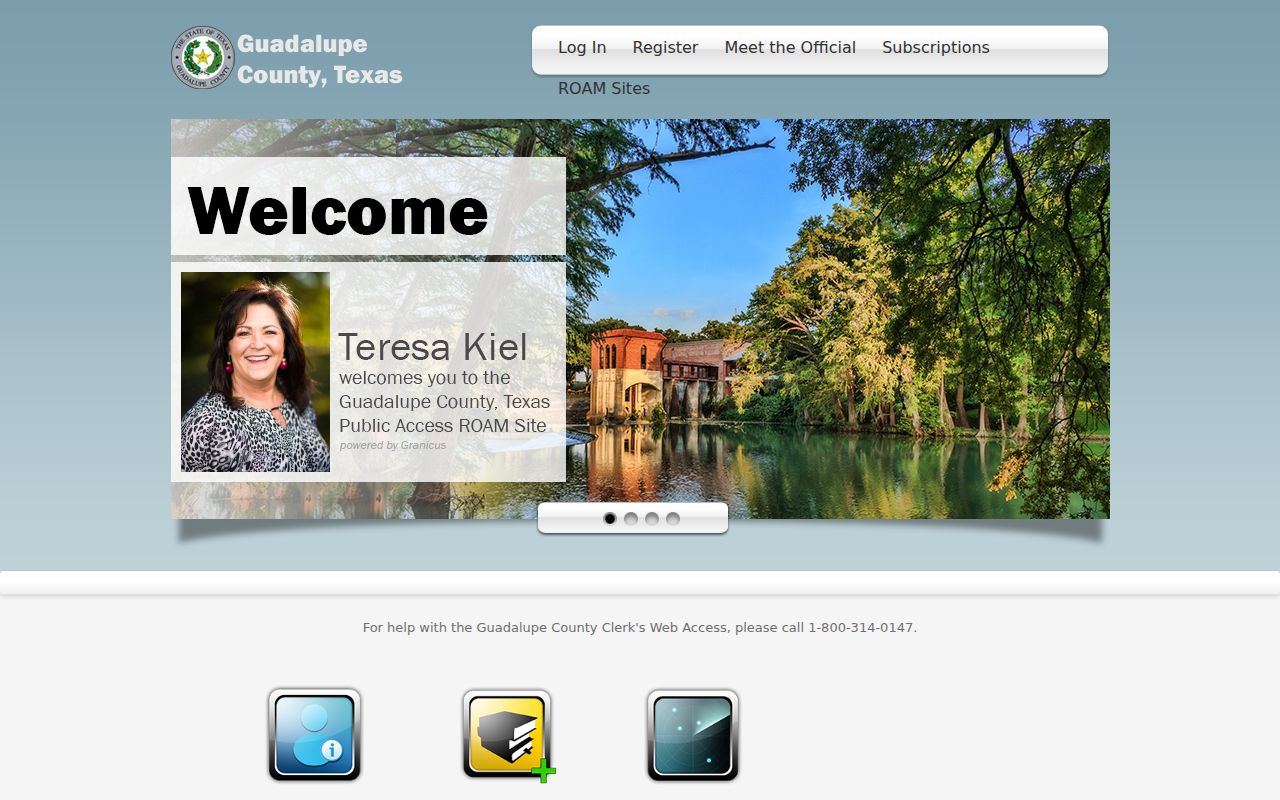
Each saved document number and legal description keeps the next step tied to the parcel rather than to a potentially changed street label.
Guadalupe County Previous Residents Index
It is not safe to assume that an ordinary online search page contains every historic Guadalupe County instrument. The County Clerk explicitly provides a distinct "Search Public Record Indexes Prior to 1970" path, but its public page does not state one exact earliest year for the regular online search. Treat 1970 as the documented operational split, not as proof that every older document is digitally available or that an earlier book begins on one fixed date.
For an exact older instrument, preserve the name spelling, legal description, book and page or document number, and date range. The County Clerk's official-record page, counter, email, and mail-copy procedure are the available channels when the index stops. Noncertified paper or electronic copies are listed at $1 per page or part, a clerk certificate for a certified copy is $5, and the copy-request form states a $10 nonrefundable processing fee per name or record if nothing is found. Electronic certified copies are available through the county's e-Certify route.
The County Clerk official-record page supplies the separate earlier-index route and its redaction warning.
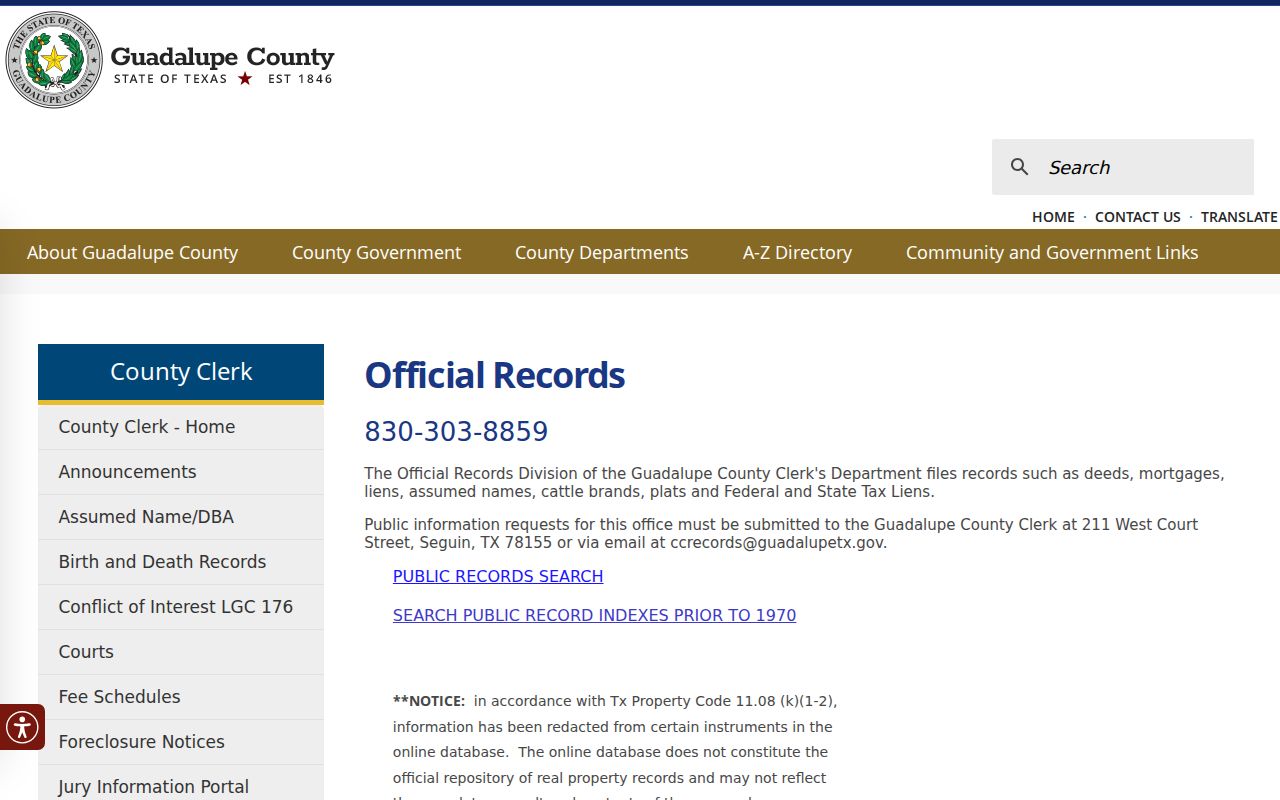
The County Clerk also warns that online material may be redacted and may not be the complete unaltered official record, so request an official or certified copy when the language of an instrument matters. The free Recording Notification Service sends an email alert when a monitored name appears in the official-record index. It is a notification tool, not proof of ownership or a substitute for reviewing the recorded instrument.
Note: The online index is a locating tool, while the official or certified copy is the record to use when a precise instrument matters.
Guadalupe County Directory Snapshots
Directories add the household layer to a Guadalupe County deed chain. Seguin has documented points in 1938, 1963, 1976, 1978, and 1980, while the New Braunfels collection has 1931, 1940, 1952-53, and 1960s-1990s entries. These are snapshots, not a continuous annual roll. A person can be omitted, listed under an initial or spouse, recorded at a business address, or found under a nearby town's publication.
Begin with the alphabetical entry, then use an address-order or criss-cross section only when the volume actually has one. The exact Seguin reverse-directory run was not confirmed in the research. Read the abbreviation key, copy the full address, and compare adjacent editions. City directory collections and their access routes are detailed on the Guadalupe County city directories page; for this backward trail, the useful question is whether the household appears before or after a deed transfer.
For a county-border move, the Sophienburg archive guide is a practical New Braunfels source. It offers appointment or research-service access and also holds German-language newspaper microfilm that can help test surname variants.
Guadalupe County Census for Previous Residents
Pair a directory with the closest public census rather than using either one alone. Federal census images from 1790 through 1950 are generally available under the 72-year release rule; 1960 was released in 2022 and 1970 is scheduled for 2032. A census records people in a household on its enumeration date. A city directory generally captures an annual address, telephone, occupation, or business notation. The two sources can confirm a move range, but neither proves every month of residence.
- Put the directory year, town, spelling, and address in a dated timeline.
- Find the closest available census and compare household members, neighborhood, and address form.
- Use FamilySearch Texas County Tax Rolls as a selective supplement for 1837-1910, not as full county coverage.
- For the lost 1890 census interval, compare 1880 and 1900 with directories, tax rolls, newspapers, probate, and deeds.
- Check the legal description and a map before deciding that two differently written addresses describe two different places.
Guadalupe County previous residents research gains strength when each source is dated and its purpose is kept clear. A voter, renter, guest, or other household member may not appear in a deed trail, and an owner may use a different mailing address.
Guadalupe County Maps for Previous Residents
Sanborn Fire Insurance Maps can establish building and street context where an address trail becomes unclear. Seguin Public Library has Sanborn reels among its Local History Room holdings. For New Braunfels, official historic material identifies editions from 1907, 1912, 1922, 1930, 1949, and 1969. A Sanborn page can show a building footprint, lot setting, construction information, or neighborhood change. It does not identify every person who lived in the building.
Use the map after collecting a directory address and legal description. Check the edition date, city, sheet, street name, and building location. Compare map evidence with a deed, plat, newspaper notice, or directory entry because a changed street name, rural route, or replat can make one address look new when the parcel is not.
The Library of Congress Sanborn searching guide explains how to identify map editions and search for relevant material.
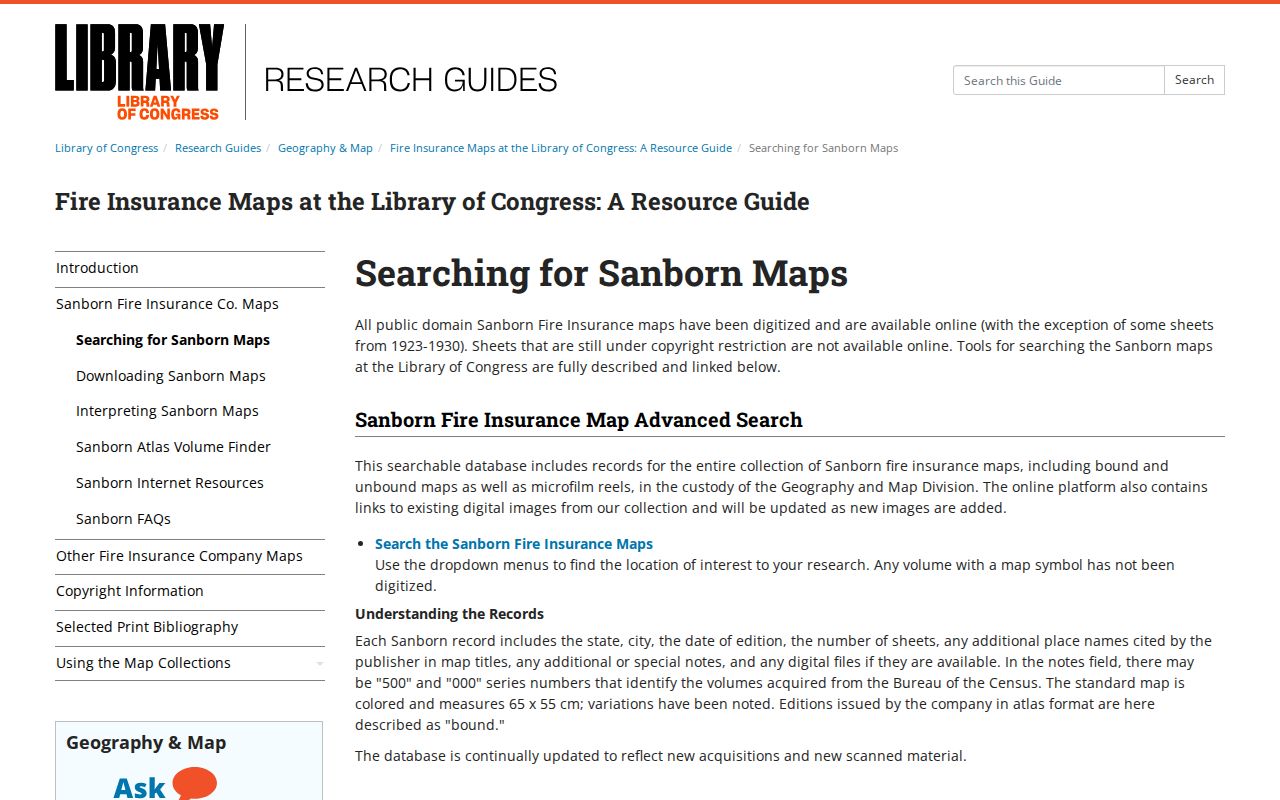
A mapped footprint can narrow the building question, while the directory, census, and deed trail remain the sources for named people and transfers.
Guadalupe County Previous Residents in 1890
The federal 1890 schedules were largely destroyed, leaving a major break in the Guadalupe County household timeline. The best local bridge is not one replacement record. Seguin Gazette-Enterprise and Seguin Gazette microfilm reaches from the late 1890s to the current year, and the Local History Room also offers census reels, family histories, yearbooks, photographs, and genealogy resources. NewsBank is identified for 2005-current material, while older newspaper research belongs on microfilm and in the catalog.
Guadalupe County records also reach beyond published directories. TSLAC and FamilySearch microfilmed county material of genealogical value dating from 1846-1877. The San Antonio genealogical catalog lists a WPA Guadalupe County probate index covering 1846-1939 and marriage-register material. Tax rolls, probate, deeds, and public notices can show a person or property connection during a period when no census page fills the gap.
The Seguin Local History Room resource page identifies the newspapers, maps, and library research access that support this work.
Limits on Guadalupe County Previous Residents
Previous residents means a documented historical trail, not permission to build a profile of living people. A recorded deed identifies named transaction parties. A directory offers an annual listing. A census captures one date. GAD distinguishes mailing from situs address. None of those sources is a complete household register. Current renters, guests, utility customers, and motor-vehicle address records are not part of this lawful house-history process.
Obituaries, probate files, and recorded heirship documents can close an older trail, but they must be read for the role actually stated. An executor or attorney address is not automatically a residence. The County Clerk and County Court at Law are the local probate routes, while newspaper microfilm and library resources can supply an obituary or notice lead. Court, juvenile, mental-health, adoption, sealed, and expunged material may be restricted.
Lawful use. Use Guadalupe County past-resident records for family history, estate research, house history, or personal property curiosity. Texas Penal Code §§42.07 and 42.072 prohibit harassment and stalking; never use records to monitor, threaten, or harm someone.